

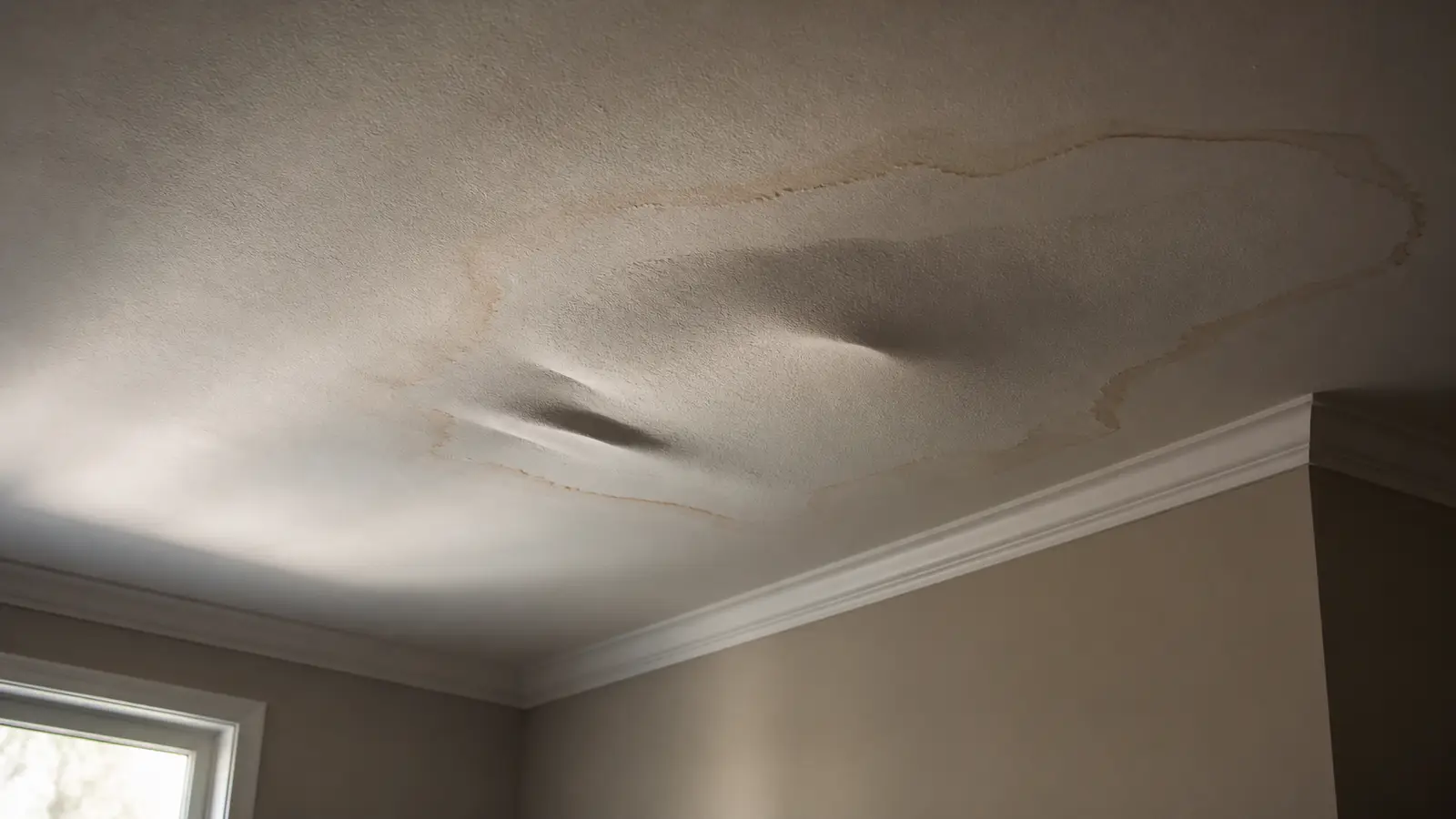
When an overhead roof leak or plumbing overflow occurs, ceiling drywall absorbs water, softening the crystallized gypsum core and causing fastener heads to pull through the paper face under the weight of wet attic insulation. If left unaddressed, sagging ceiling sheetrock can suddenly collapse. A proper structural repair requires removing saturated insulation, re-securing adjacent gypsum panels into ceiling joists every 7 inches on center using 1-5/8" coarse-thread screws with backer blocking, floating joints with low-shrinkage chemical hot mud, and sealing with 100% pure shellac-based stain-blocking primer to permanently lock in water tannins. In 2026, South Sound ceiling repairs cost $650 to $1,450+.
The Ceiling Nightmare: Yellow Rings and the Overhead "Belly"
Few things cause more immediate panic for a homeowner than looking up to see an ugly yellow water ring expanding across the ceiling—or worse, noticing the drywall is bowing downward into a noticeable "belly."
Whether the water came from a burst upstairs bathroom supply line in Lacey, an overflowing toilet in Olympia, or winter storm wind-driven rain penetrating an attic flashing in Tacoma, ceiling drywall damage requires immediate structural and chemical intervention.
Many homeowners assume that painting over the yellow stain will fix the problem. But if you roll standard latex paint over a water stain without structural re-fastening and chemical sealing, two severe issues occur:
- The Stain Bleeds Through: Water-soluble mineral tannins in the stain dissolve into water-based latex paint, causing the yellow halo to bleed through four or five coats of paint.
- The Ceiling Sags and Collapses: Wet gypsum loses its structural integrity. As the core softens, the weight of the sheetrock and wet attic insulation causes the board to pull away from the ceiling joists, creating a severe fall hazard.
The Physics of Ceiling Sag: Fastener Pull-Through Dynamics
Drywall installed on ceilings is under continuous gravitational tension. In Western Washington residential construction, ceiling panels (typically 1/2-inch or 5/8-inch gypsum) are fastened to wood ceiling joists spaced 16 or 24 inches on center.
| Ceiling Component Layer | Normal Dry State | Water-Saturated State | Mechanical Failure Mode |
|---|---|---|---|
| Top: Wood Ceiling Joists | Rigid 2x6 or 2x8 timber joists holding fasteners firmly. | Absorbs moisture; swelling slightly. | Screws remain firmly embedded in wood joists. |
| Middle: Attic Insulation | Lightweight dry fiberglass batt or blown cellulose. | Absorbs hundreds of pounds of water weight. | Heavy downward hydrostatic pressure pushes against ceiling board. |
| Bottom: Gypsum Sheetrock | Dense crystallized gypsum core bonded to heavy paper face. | Gypsum core dissolves into soft paste; paper delaminates. | Fastener Pull-Through: Screw heads pull completely through soft paper; ceiling sags 1"-2" and collapses. |
Damage Stages & Collapse Risk Matrix
| Damage Stage | Physical Condition of Drywall | Safety & Structural Risk | Required Restoration Action |
|---|---|---|---|
| Stage 1: Surface Staining | Water drips onto face paper but dries quickly; gypsum core remains rigid. | Cosmetic only. Tannin stains will bleed through paint unless sealed. | Verify wood moisture (<15%), apply shellac stain sealer, paint corner-to-corner. |
| Stage 2: Core Softening (1/4"-1/2" Sag) | Gypsum core absorbs moisture; paper face delaminates; screw heads pull partially. | Moderate hazard. Fasteners losing grip; risk of progressive sag. | Re-secure adjacent board every 7" into joists with 1-5/8" screws; float with hot mud. |
| Stage 3: Fastener Pull-Through (1"+ Belly) | Fastener heads pull completely through paper; board hangs by tape on edges. | Severe Collapse Risk. Wet insulation weight can cause sudden ceiling drop. | Surgical cutout of compromised board; vacuum wet insulation; install 2x4 blocking; re-hang moisture-resistant drywall. |
Why Standard Paint Will Never Hide a Water Stain
Have you ever applied three coats of high-end ceiling paint over a water ring, only to watch the ugly yellow stain reappear 12 hours later?
This happens because of basic solvent chemistry:
- Water-Soluble Mineral Tannins: When water travels through wood framing and drywall gypsum, it dissolves organic wood tannins, mineral salts, and oxidized gypsum binders.
- The Latex Reaction: Standard interior ceiling paints are water-based emulsions. When you roll water-based latex paint over a dried water stain, the water in the paint instantly re-liquefies the tannins, drawing them to the surface as the paint dries.
The only way to permanently block water stains is to apply a solvent-based, non-porous barrier that does not dissolve in water. Solis Interiors uses 100% pure shellac-based stain-blocking primer or high-solids alkyd primer, creating an impermeable barrier that permanently locks tannins beneath the topcoat.
The Solis 5-Stage Ceiling Restoration Workflow
Restoring a water-damaged, sagging ceiling requires a methodical combination of carpentry, structural fastening, and artisan finishing:
- Containment & Moisture Diagnostic: Before beginning repairs, we inspect the ceiling with digital moisture meters to ensure the plumbing leak or roof penetration is 100% resolved and wood framing has dried to below 15% Wood Moisture Content (WMC).
- Surgical Cutout of Saturated Drywall: Any gypsum that has softened, sagged past 1/2-inch, or shows paper delamination is cleanly cut out square to the nearest ceiling joists using dust-controlled oscillating saws. Saturated attic insulation is safely extracted.
- Solid 2x4 Sister Blocking & Re-Fastening: We install solid 2x4 wood blocking flush between ceiling joists to give every cut edge solid structural backing. We then re-secure all adjacent sagging drywall by driving 1-5/8" coarse-thread drywall screws every 7 inches on center into the joists.
- ASTM C1396 Board Hanging & Chemical Hot Mud: We hang replacement ASTM C1396 moisture-resistant drywall and bed high-tensile mesh in low-shrinkage chemical-setting hot mud. We feather the joints 14 to 18 inches wide across 3 passes to ensure the repair is completely flush with the surrounding ceiling.
- Pure Shellac Sealer & Dead-Flat Topcoat: We seal the entire repair zone and surrounding ceiling with high-solids shellac primer. Once dry, we apply two coats of premium dead-flat ceiling paint to eliminate all light sheen reflections.
2026 Ceiling Repair Pricing in Thurston & Pierce County
Ceiling drywall repairs carry an overhead labor factor (+20% to +35%) due to gravity, staging, scaffolding, and working above living spaces.
Based on 2026 Western Washington trade labor rates, here is what South Sound homeowners can expect:
| Project Scope | 2026 South Sound Cost Range | What is Included in the Scope |
|---|---|---|
| Surface Water Stain Sealing & Ceiling Painting (No Sag) | $450 - $750 | Drop-cloth containment, shellac stain-blocking primer, 2 coats flat ceiling paint |
| Small Ceiling Leak Cutout & Re-Fastening (1-4 sq. ft.) | $650 - $950 | Cutout, 2x4 blocking, joist re-screwing every 7", moisture-resistant drywall patch, hot mud, texture match |
| Large Sagging Ceiling Reconstruction (4-16 sq. ft.) | $950 - $1,650+ | Insulation extraction, multi-joist sister blocking, board replacement, 16"-wide feathering, spray texture |
| Full Room Ceiling Re-Float & Paint (Up to 200 sq. ft.) | $1,450 - $2,800 | Re-securing entire ceiling, floating all joints flat, high-solids primer, full corner-to-corner paint |
| High / Vaulted Ceiling Surcharge (Over 10 ft) | +20% to +35% | Scaffolding setup, specialized ladder staging, overhead safety protocols |
Frequently Asked Questions (FAQ)
Can you save a water-stained ceiling without cutting it open?
Yes, if the board is structurally sound. If the leak was caught quickly, the gypsum core did not soften, and the ceiling is not sagging, we verify the framing is dry (<15% WMC), seal the stain with 100% pure shellac-based stain-blocking primer, and paint the ceiling corner-to-corner.
How do you match existing ceiling textures like orange peel or popcorn?
Solis Interiors carries commercial continuous-flow air compressors and hopper guns. We dial in pneumatic air pressure and compound viscosity on-site to match your ceiling's exact original texture, feathering the overspray 12 to 18 inches outward so the boundary dissolves invisibly.
Why do you use dead-flat paint on ceilings?
Any paint with sheen (such as satin or semi-gloss) acts like a mirror on a ceiling, reflecting ambient window light and highlighting every framing imperfection and drywall seam. Dead-flat ceiling paint diffuses light evenly, making the ceiling look perfectly uniform and smooth.
Authoritative Trade Standards & Building Codes
- Institute of Inspection, Cleaning and Restoration Certification (IICRC): IICRC S500: Standard for Professional Water Damage Restoration
- Gypsum Association (GA): GA-216: Application and Finishing of Gypsum Panel Products
- American Society for Testing and Materials (ASTM): ASTM C1396: Standard Specification for Gypsum Board
Schedule a Walkthrough with Solis Interiors
Contact master finisher Jesus Solis for an on-site evaluation, expert substrate consulting, and itemized proposal across the South Sound.
- Direct Phone: (360) 350-8616
- Online Quote Request: Request Ceiling Water Damage Repair Estimate
- Service Areas: Lacey, Olympia, Tumwater, Tacoma, Lakewood, DuPont, Gig Harbor, Yelm, Centralia.