
Repair or Replace Damaged Drywall? A South Sound Scope Guide
Solis Interiors repairs water-damaged drywall across Thurston, Pierce, and Lewis counties. Before you choose a repair scope, confirm the water source and which material is ready for reconstruction.
For a buyer comparing drywall repair bids across Thurston, Pierce, and Lewis counties, including Olympia, Lacey, Tacoma, and nearby South Sound communities. A stain, soft spot, or opened wall does not by itself tell you how much drywall to replace. First settle the source of the water and the drying or mitigation status. Then choose the smallest reconstruction scope that addresses the affected material and leaves a finish you can live with. A quote that skips either decision is difficult to compare with one that includes both.
Short answer: A small, stable, dry opening may be a local patch. A wider affected area or damaged backing may need new board and a larger finish area. A ceiling or long wall that cannot be blended acceptably may make a broader skim, texture, or painting scope more sensible than repeatedly patching isolated spots. None of these choices substitutes for identifying and fixing the water source.
The decision starts before the drywall bid
The first question is not “How much to patch the stain?” It is “Is this wall ready to be rebuilt?” A leak source, failed plumbing connection, roof problem, or other water entry needs attention from the relevant trade. If a restoration company has opened and dried the assembly, ask for its scope and clearance information. If it has not, do not assume paint or new board will solve what is behind the surface. The EPA's moisture guidance puts source control and drying ahead of surface repair.
For a Lacey homeowner with a ceiling stain below an upstairs bathroom, the drywall question depends on whether the leak has been corrected and what the opened ceiling reveals. After a larger water event in Olympia, a mitigation report may already define the removal boundary. The same room can move from “patch and paint” to “replace board and insulation, then finish” once the opening is visible.
Ask who is responsible for each handoff: stopping the leak, mitigation, any testing, removal, reconstruction, primer, and paint. Solis can bid the drywall work it performs and provide Xactimate-ready billing for that scope. A reconstruction proposal should not silently imply that Solis performed moisture mitigation or certified the assembly dry.
Which scope is worth buying?
Which repair scope is worth comparing?
| If the project looks like this | Scope worth discussing | Why it may be the better choice | What could change the decision |
|---|---|---|---|
| A small opening after the source was corrected and the assembly is ready | Local patch, tape, finish, and a planned paint boundary | Limits disturbance when surrounding board and finish are sound | Damaged backing, an inaccessible cavity, or a difficult texture match |
| Board has been removed across several framing bays | Re-board the affected opening, then finish a defined surrounding area | Reconstructs the actual removal area rather than concealing it | Insulation, blocking, or a specified wall assembly needs more work |
| The repair crosses a prominent sightline or ceiling field | Broader texture blend, smooth-wall finishing, or paint area | A larger finish boundary can be less noticeable than several isolated patches | Existing finish, light direction, sheen, and budget |
| Water source or drying status is still unresolved | Defer the finish decision and resolve the upstream work | Avoids pricing a surface before the underlying scope is known | Mitigation findings and the exposed condition |
A photograph helps frame the conversation, but the exposed opening and adjacent finish often determine the final scope. The EPA's cleanup basics also caution against painting over moldy or damp surfaces; there is no universal cosmetic shortcut.
Why a smaller patch can cost more later
“Smallest opening” and “best-value repair” are not always the same thing. A narrow patch in the middle of a smooth, brightly lit wall may require a wide finish and paint blend to look intentional. A ceiling with an older, irregular texture may resist a tiny invisible match. The right question is not whether a patch is technically possible. It is whether its finished edge, schedule, and possible rework make sense beside a somewhat larger single scope.
Conversely, a full-wall replacement should not be the default merely because the damage looks alarming in a close photo. If the source is fixed, the affected section is known, and surrounding material is sound, a bounded repair may be appropriate. Ask a bidder to explain the proposed cut line and finish line separately. They are not necessarily the same boundary.
Why the finish belongs in the first estimate
A drywall opening can be closed correctly yet leave a visible rectangle if texture, primer, and paint were treated as afterthoughts. Decide whether the goal is a functional repair, a close match under normal use, or a broader wall/ceiling refresh. Those are different purchasing decisions. Show the adjacent surface in daylight and with the room's usual lights on. Tell the bidder whether paint is included and where the paint transition ends. Do not assume a promise of “seamless” appearance in every angle of light.
Make repair bids comparable
Before asking for prices, gather:
- A wide photo showing the entire wall or ceiling and a close photo of the damage or open cavity.
- The source-repair and mitigation status, plus any restoration scope or insurer document you have.
- Approximate dimensions of the opening and the larger visible surface; identify cabinets, tile, fixtures, or high ceilings that limit access.
- The existing texture or smooth finish and the desired paint boundary.
- Whether the estimate should include removal, backing, insulation replacement if specified, board, tape, texture or skim, primer, paint, and cleanup.
Then compare bids line by line. Does one include only board replacement while another includes the finish and paint? Is removal already handled by mitigation? Is an allowance hiding an unresolved condition? A lower number may simply stop earlier. If the wall is part of a rated or acoustic assembly, provide the project documents rather than asking a drywall contractor to invent a replacement specification from a photo.
For an insurance-related job, share the insurer's or restorer's scope so the drywall portion can be reconciled. Solis can provide Xactimate-ready billing for its own repair work, but the insurer, adjuster, mitigation contractor, and drywall contractor do not all perform the same role. Ask each party which line items it owns.
The sensible next step
Choose the reconstruction boundary after the upstream problem is controlled. Choose the finish boundary with the room in view. If you are still unsure whether to patch or replace, request a bid that shows both alternatives and makes the assumptions visible. That is more useful than a single “drywall repair” total without a finish description.
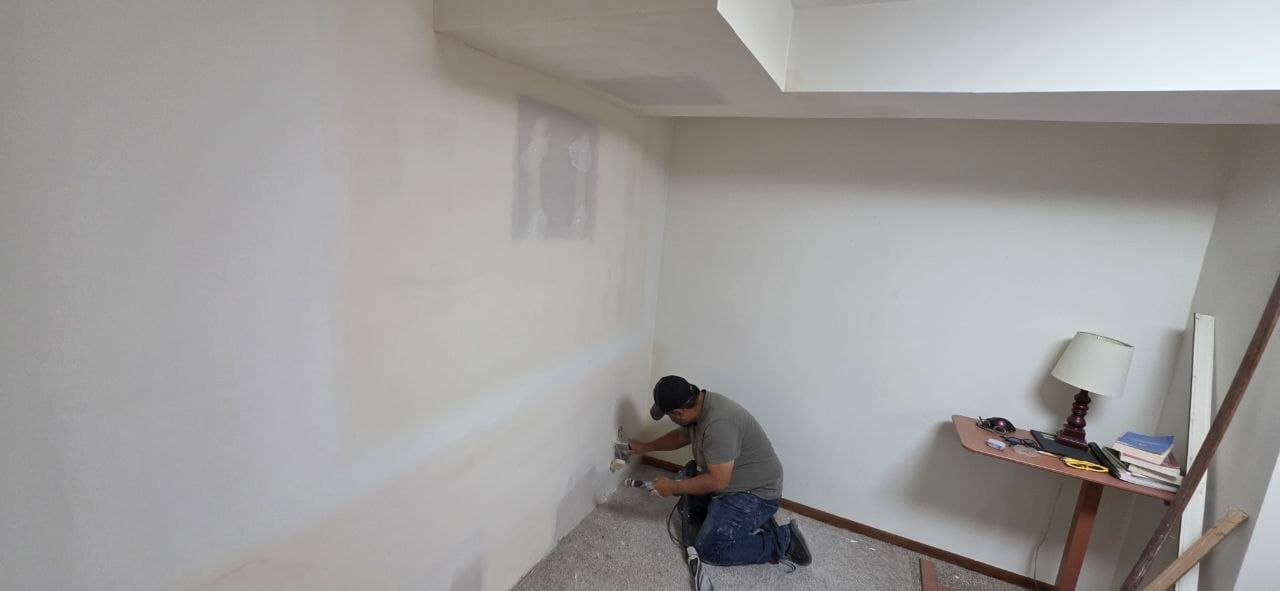
Send Solis Interiors wide and close photos, the source-repair status, and any mitigation scope when requesting a water-damage drywall repair estimate. For a dry, isolated opening, see general drywall repair and patching. If the finish is still undecided, compare texture matching with smooth-wall finishing. You can also see Solis crews at work in the jobsite gallery.
A useful alternate-scope request
A hypothetical bid request can make the uncertainty visible without pretending the condition is known. For example, ask for “Alternate A: patch the opened area after the source is corrected and the backing is sound” and “Alternate B: replace the affected board across the exposed framing bays, then finish the defined surrounding area.” Those are scope descriptions, not predictions about what the wall will require. Ask the bidder to state what observation would move the work from A to B.
Keep three boundaries separate in the written response: the area removed or opened, the area receiving new board, and the area receiving tape, texture, skim, primer, or paint. A small opening can still need a wider finish boundary when the repair sits in a strong sightline. A larger board replacement may need little extra finish if the surrounding surface will be repainted as one field. Asking for those boundaries prevents a buyer from comparing a board-only number with a finished repair.
If the project is an insurance claim, attach the restoration or adjuster scope and ask the drywall bidder to identify which line items it accepts, questions, or excludes. The buyer should not ask a drywall finisher to certify drying or mold clearance. A clear handoff protects the reconstruction estimate and leaves source control, testing, and mitigation with the parties responsible for them.
Ask for the decision trigger
A comparable proposal can state a trigger such as “if the exposed backing is unsound, price the re-board alternate” without predicting that the condition exists. That gives the owner a practical decision point and keeps the quote honest when demolition reveals more than a photograph showed.
The quote should identify that trigger plainly.