

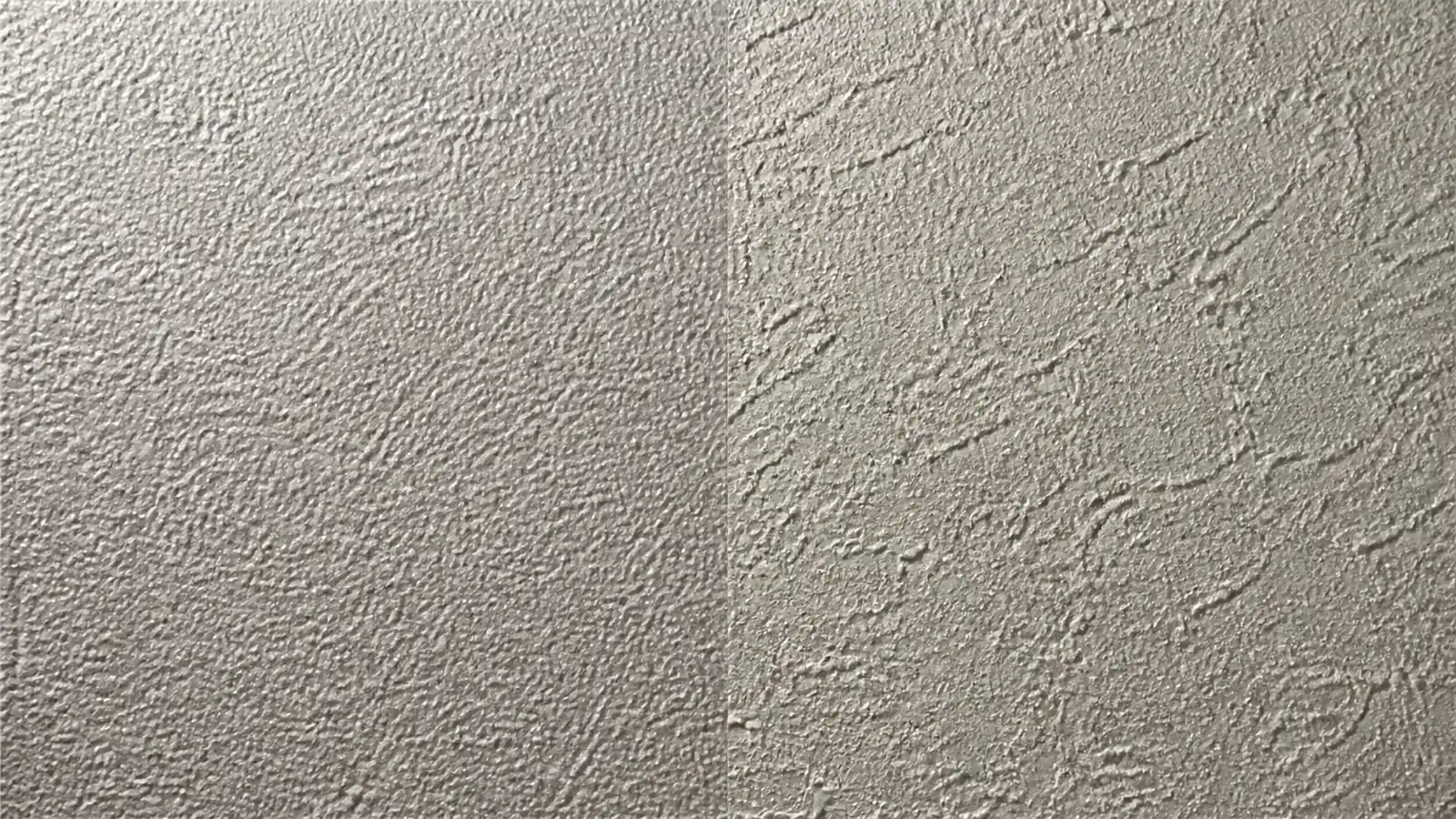
Under Association of the Wall and Ceiling Industry (AWCI Manual 12-B) standards, invisible drywall texture matching requires calibrating three mechanical variables: compound viscosity, air compressor pressure (PSI), and pneumatic spray nozzle orifice size. Aerosol texture cans almost always fail because they produce inconsistent droplet velocity and lack feathering control. Professional texture blending requires feathering spray droplets 12 to 18 inches outward into undisturbed drywall and sealing with high-solids PVA primer to prevent textural halo flashing under Pacific Northwest natural lighting.
Why do drywall patches look like obvious bulges or bullseyes?
We've all seen it: a homeowner or handyman patches a hole from an old electrical outlet or doorknob, sprays a can of hardware-store texture over it, rolls a coat of paint, and steps back—only to see a glaring, raised "bullseye" circle in the middle of the wall.
Even if the paint color matches perfectly, your eye immediately catches the patch.
Why? Because human vision does not perceive a wall as a flat color—it perceives how microscopic shadows fall across the surface texture.
When the pattern, droplet size, droplet density, or blend distance of a repair does not match the original wall, sunlight streaming through your windows catches the difference, making the repair look like an obvious scar.
Patch Quality Comparison: DIY Can Patch vs. Solis Pneumatic Blend
| Repair Characteristic | Typical DIY Aerosol Spray Can Patch | Solis Precision Pneumatic Texture Blend |
|---|---|---|
| Boundary Transition | Abrupt circular edge; creates hard shadow outline | 12"-18" Feathered Gradient: Droplet density dissolves to zero |
| Droplet Scale Consistency | Coarse blobs at start, watery mist at end (can chills) | Continuous Uniform Scale: Calibrated commercial compressor |
| Material Formulation | Solvent-based chemical propellant (shrinks rubbery) | Water-based formulated gypsum compound matching wall mud |
| Porosity Seal | Painted directly over mud (causes chalky sheen flashing) | High-solids PVA primer: Equalizes 100% paint reflectance |
| Visual Result | Obvious "bullseye" visible across room under window light | Optically seamless: Completely invisible under grazing light |
Common Wall Textures in Western Washington Homes
Homes built in Lacey, Olympia, Tacoma, and Pierce County from 1970 to the present feature several distinct texture styles. Each requires completely different equipment and compound preparation:
| Texture Style | Visual Characteristic | How It Is Created & Calibrated |
|---|---|---|
| Fine Orange Peel | Subtle, continuous stipple resembling an orange skin. | High air pressure (40-50 PSI), low compound viscosity, small nozzle orifice (3-4mm). |
| Medium / Heavy Splatter | Distinct raised droplet dots across the surface. | Medium air pressure (25-35 PSI), medium viscosity, medium nozzle orifice (6-8mm). |
| Spanish Knockdown | Splatter droplets that are allowed to set up for 10-15 min, then flattened with a wide curved blade. | Low air pressure (20-30 PSI), thick mud viscosity, flattened with a 12"-18" rubber/stainless knockdown knife. |
| Skip Trowel / Santa Fe | Hand-applied undulating mud planes creating a soft Mediterranean stucco look. | 100% hand-troweled using formulated finishing compound held at a shallow angle with intermittent skips. |
| Popcorn / Acoustic | Heavy aggregate texture with deep sound-dampening craters. | Sprayed with hopper guns using vermiculite or aggregate binders. |
Why Aerosol Texture Cans Almost Always Fail
The home improvement aisle is lined with aerosol "spray texture in a can." While marketed as a 5-minute fix, professional drywall finishers rarely touch them for living area repairs. Here is why aerosol cans fail:
- Inconsistent Pressure Curve: Aerosol cans rely on chemical propellants. As you spray, the can cools down rapidly (latent heat of vaporization), dropping internal pressure within 30 seconds. This changes the droplet size halfway through your patch, creating fine mist at first and giant blobs at the end.
- Solvent-Based Shrinkage: Aerosol texture contains chemical solvents that dry rubbery and shrink drastically, creating a different texture profile than water-based joint compound.
- Zero Feathering Control: Aerosol nozzles spray in a concentrated cone. They cannot create the delicate 12-to-18-inch gradient needed to dissolve the patch boundary into the surrounding wall.
The 4 Scientific Rules of Invisible Texture Matching
At Solis Interiors, our master craftsmen treat texture matching as an exact science based on AWCI Technical Manual 12-B:
- Compound Viscosity Calibration (The "Pancake Batter" Rule): Joint compound straight from the bucket is too thick for spray texture. We thin professional all-purpose compound with precise ratios of water to achieve the exact surface tension required for your home's specific texture profile.
- Pneumatic Air Pressure & Orifice Calibration: We use commercial continuous-flow air compressors and hopper guns. Adjusting the air regulator by just 5 PSI changes an orange peel droplet from a fine mist (45 PSI) to a medium splatter (30 PSI).
- The 18-Inch Feathering Zone: We never stop texture at the edge of the drywall patch. We spray the core of the patch to full density, then fan our spray pattern 12 to 18 inches outward in overlapping sweeping arcs, gradually tapering droplet spacing until it dissolves into the original wall.
- High-Solids PVA Primer Sealing: Texture is made of water-based compound. If you roll paint directly over fresh texture, the mud sucks moisture out of the paint, creating a dull, chalky patch (sheen flashing). We seal all textured repairs with high-solids polyvinyl acetate (PVA) primer before applying color-matched finish coats.
2026 Texture Matching & Drywall Repair Pricing in South Sound
Based on 2026 Western Washington contractor labor rates (SOC 47-2081), here is what homeowners can expect for professional patch and texture repairs:
| Project Scope | 2026 South Sound Cost Range | What is Included in the Scope |
|---|---|---|
| Small Isolated Patch & Texture Match (1-4 sq. ft.) | $350 - $650 | Solid timber backing, moisture-resistant patch, hot mud, pneumatic texture match, PVA primer |
| Large Wall Cutout / Plumbing Access (4-16 sq. ft.) | $650 - $1,250 | Board replacement, multi-pass joint feathering, custom texture blend, stain-blocking primer |
| Full Accent Wall Texture Re-Spray (Up to 150 sq. ft.) | $750 - $1,600 | Scraping failed DIY patches, floating wall flat, re-spraying uniform orange peel/knockdown across whole field |
| Full Room Conversion to Smooth (No Texture) | $3.80 - $6.50 / sq. ft. | Scraping texture ridges, bonding primer, 2-3 tight Level 5 skim coats, dustless HEPA sanding |
| Paint Matching Add-On (Corner-to-Corner) | +$1.20 - $2.50 / sq. ft. | Spectrophotometer digital color analysis, 2 coats premium architectural paint |
Frequently Asked Questions (FAQ)
Can you match custom hand textures like skip-trowel or Santa Fe?
Yes. Hand-applied textures require artisan trowel work rather than spray guns. Solis Interiors brings over 35 years of dedicated finishing experience. We test sample trowel techniques on scrap drywall boards on-site to match the exact depth, angle, and rhythm of your original hand texture.
How do you match the paint color if I don't have the original paint can?
When paint codes are lost, we cut a clean 2x2 inch sample chip from the damaged drywall area and analyze it using a digital spectrophotometer at professional commercial paint suppliers. We match both the exact pigment formula and the sheen (matte, eggshell, satin, semi-gloss).
When is it better to skim a wall smooth instead of matching texture?
If a wall has 5 or 6 failed previous patches, extensive settling cracks, or inconsistent textures from multiple past remodels, adding another patch often highlights the wall's overall unevenness. In those cases, we provide an honest quote to skim the entire wall smooth, giving you a fresh, modern surface.
Authoritative Trade Standards & References
- Association of the Wall and Ceiling Industry (AWCI): AWCI Technical Manual 12-B: Standard Practice for Surface Texture Application
- Painting Contractors Association (PCA): PCA Standard P1 & P14: Architectural Surface Guidelines
- Gypsum Association (GA): GA-214: Recommended Levels of Finish for Gypsum Panel Products
Schedule a Walkthrough with Solis Interiors
Contact master finisher Jesus Solis for an on-site evaluation, expert substrate consulting, and itemized proposal across the South Sound.
- Direct Phone: (360) 350-8616
- Online Quote Request: Request Drywall Texture Matching Estimate
- Service Areas: Lacey, Olympia, Tumwater, Tacoma, Lakewood, DuPont, Gig Harbor, Yelm, Centralia.