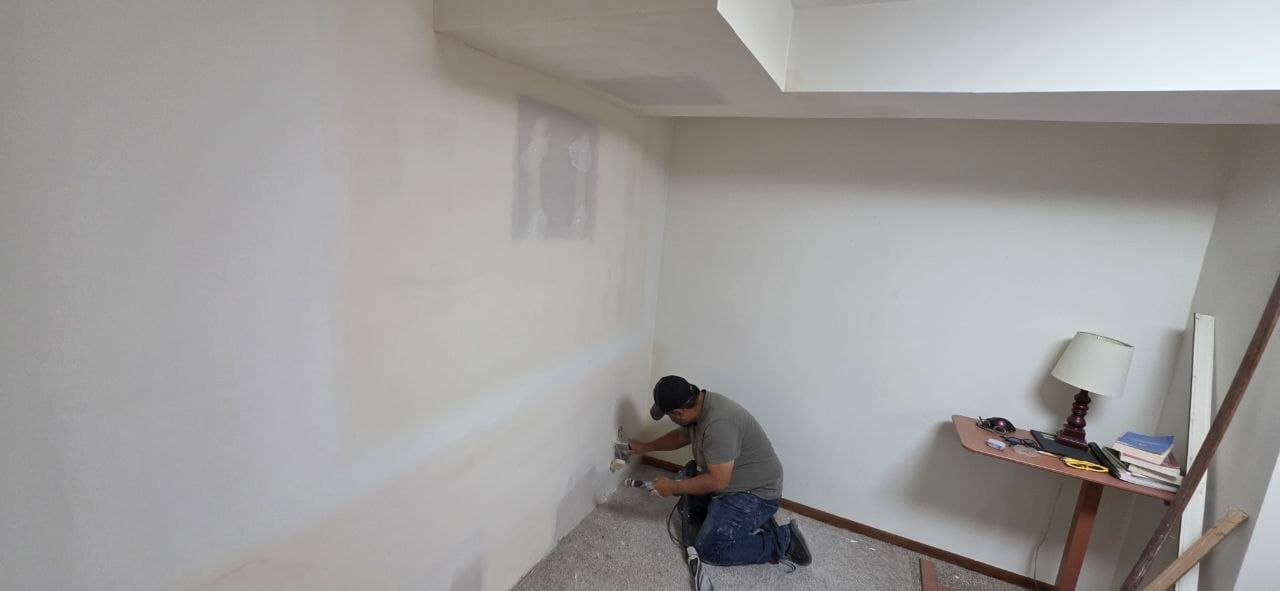

Smooth Wall Conversion or Texture Matching? A South Sound Finish Guide
Solis Interiors offers texture matching and smooth-wall finishing across Thurston, Pierce, and Lewis counties. Decide whether you want a repair to blend into the room or a new finish across a larger surface.
For a buyer deciding whether to preserve the look of an existing room or change it. A repaired wall needs a finished surface, but “match the texture” and “make it smooth” lead to different work areas, paint boundaries, and expectations. The right choice is not always the more expensive one. It is the one that fits the room you intend to keep using.
Short answer: Match existing texture when the repair is local and the surrounding surface is sound and worth retaining. Consider smooth-wall conversion when a continuous, calmer finish is the actual design goal, especially if several patches or prior textures make matching each repair less attractive. Before requesting a quote, decide whether the finish boundary is a patch, one wall, one room, or connected rooms.
Decide what you want the room to look like afterward
A buyer may begin with “fix this hole” but actually wants an updated room. Another may ask for smooth walls because a contractor suggested it, even though the rest of the home has a texture they like. Those are different projects. Walk the room and point out the parts you would keep if there were no damage. If the answer is “most of it,” texture matching may be the better starting bid. If the answer is “none of this finish,” paying to match a patch before converting the wall is likely a detour.
For a Tumwater room with a single repaired outlet opening, the question may be whether the old pattern can be blended acceptably. In an Olympia renovation where several wall sections are already open and the owner plans a different paint scheme, a wall-wide conversion may be worth pricing. Photos help with an initial discussion; an in-person look at the surrounding surface may change the scope.
Compare the choices as purchases
Which finish boundary fits the room?
| Choice | Why a buyer might choose it | What the bid must define | Common disappointment to avoid |
|---|---|---|---|
| Local texture match | Keep a sound, familiar room finish with limited disruption | Repair area, blending area, primer, paint boundary | Expecting an invisible patch in every angle of light |
| Refinish one complete wall | Make a visible plane consistent while leaving other walls alone | Corner-to-corner boundary, prep, selected texture or smooth finish, paint | Ending in the middle of a long sightline |
| Convert a whole room to smooth | Achieve a deliberate new room appearance | Existing-texture preparation, board condition, finish level, trim/fixture protection, paint | Assuming “smooth” is one fixed specification |
| Stage connected rooms | Spread work while planning a consistent eventual finish | Which rooms are included now and how later transitions will meet | Paying twice for edge work or repainting at the same connection |
These choices can be quoted as alternatives instead of forced into a single yes-or-no answer. Ask for a base repair that restores function, then a priced alternate for the full wall or room if the design decision is still open. That makes the added value visible rather than burying it in the contractor total.
Why texture matching has a limit
An existing finish has age, paint layers, application variation, and lighting. A new patch can imitate the pattern without reproducing every irregularity in the surrounding field. The farther a repaired patch sits from a natural break, the more the eye may notice it. A bidder should describe the blend area and the paint transition, not simply write “match existing” as if that alone defined the outcome.
Look at the wall in the light you normally use and ask, “What will this look like from where we actually stand?” If the room already has several older patches, another local match may be the least disruptive short-term answer. It may also be time to price a complete wall or room finish so the new repair doesn't stand out beside the old ones. Tell us which result you want to compare.
Why smooth-wall conversion is more than sanding
Converting an existing textured surface involves preparing what is there, addressing visible irregularities, and selecting a final finish appropriate to the desired look. It is not equivalent to lightly sanding a repair. Previous texture may conceal joints or inconsistent board planes. Window light, wall sconces, and paint sheen can make the new surface more visually demanding than the old one. The Gypsum Association's finish-level reference is useful when the buyer, finisher, designer, and painter need a common specification; it does not override the actual condition of the wall.
Ask for texture preparation, the new finish, and final paint to be identified in the quote. If you're living in the home during work, tell us which rooms must stay usable and what needs protection. Solis uses dust-extraction vacuums on nearly every job and commercial HEPA extraction when needed. The room and the scope determine how we set up the work area.
The light-and-paint check
Before selecting either route, look at the wall with the light that will remain after the work. A low sun through a large window and a light positioned parallel to a wall can reveal different things than a central ceiling fixture. Choose the intended paint color and sheen early if possible, because the finish and coating choices interact. If paint is not yet chosen, say so and ask what assumptions the bid uses.
For a single-wall project, a corner-to-corner paint boundary may be easier to define than a patch-shaped touch-up. For connected walls, the owner may want a room-wide paint scope, but it should be an explicit choice, not an automatic upsell. If trim, cabinetry, or wall-mounted hardware will be changed later, mention that too. The sequence can affect whether the finished wall is disturbed again.
What to send for two comparable bids
What should the buyer send with the estimate request?
- A wide room photo plus close views of the damage and existing texture.
- Which walls you are willing to refinish, and which you definitely want to leave alone.
- The intended paint color and sheen, or a note that these are undecided.
- Where light comes from during the hours the room is most used.
- Any earlier patches, wallpaper, moisture history, or concealed work you know about.
- Whether the quote should include primer, paint, fixture removal/reinstallation, room protection, and cleanup.
Ask for a local-match option and a broader-refinish option on the same room assumptions. Compare disruption and final appearance as well as price. The smaller scope may be the right one for a rental turnover, a bedroom, or a single isolated repair; a deliberate conversion may make more sense for a living area being redesigned. Those are buyer priorities, not universal rules tied to a city or housing type.
Send Solis Interiors a wide room photo and a close view of the existing texture when requesting a texture-matching estimate or a smooth-wall finishing estimate. If you want a smooth painted result, use the Level 5 project guide to plan the full scope; the Level 4 versus Level 5 article compares the finish levels. Solis's work gallery shows the crew and surfaces at work.
Compare two finish boundaries in one room
Suppose one repaired wall sits beside a window and a second wall continues around a corner. A local texture-match alternate could stop at the corner and preserve the existing room finish. A smooth-wall alternate could carry preparation and paint across both walls so the corner does not become a visible stopping point. Ask each bidder to name the walls, the corner or doorway where the finish stops, and any trim or cabinetry that changes the boundary. A marked-up room photo can make these two scopes easier to compare than a service label alone.
Ask each bidder to separate preparation of the existing surface from the new finish. “Match existing” does not say whether loose texture, old paint, previous patches, or uneven board are included. For a smooth conversion, ask what surface condition the price assumes and which corrections become an alternate if uncovered. For a local blend, ask how the texture type and paint transition will be established without promising that every angle of light will disappear.
The paint handoff matters in either route. Record the intended color and sheen when known, identify who supplies primer and paint, and state whether fixture removal, room protection, and cleanup are included. A buyer choosing between a narrow repair and a room-wide conversion is choosing a visible boundary as much as a material. That is why two bids with the same service label can purchase different finished rooms.