

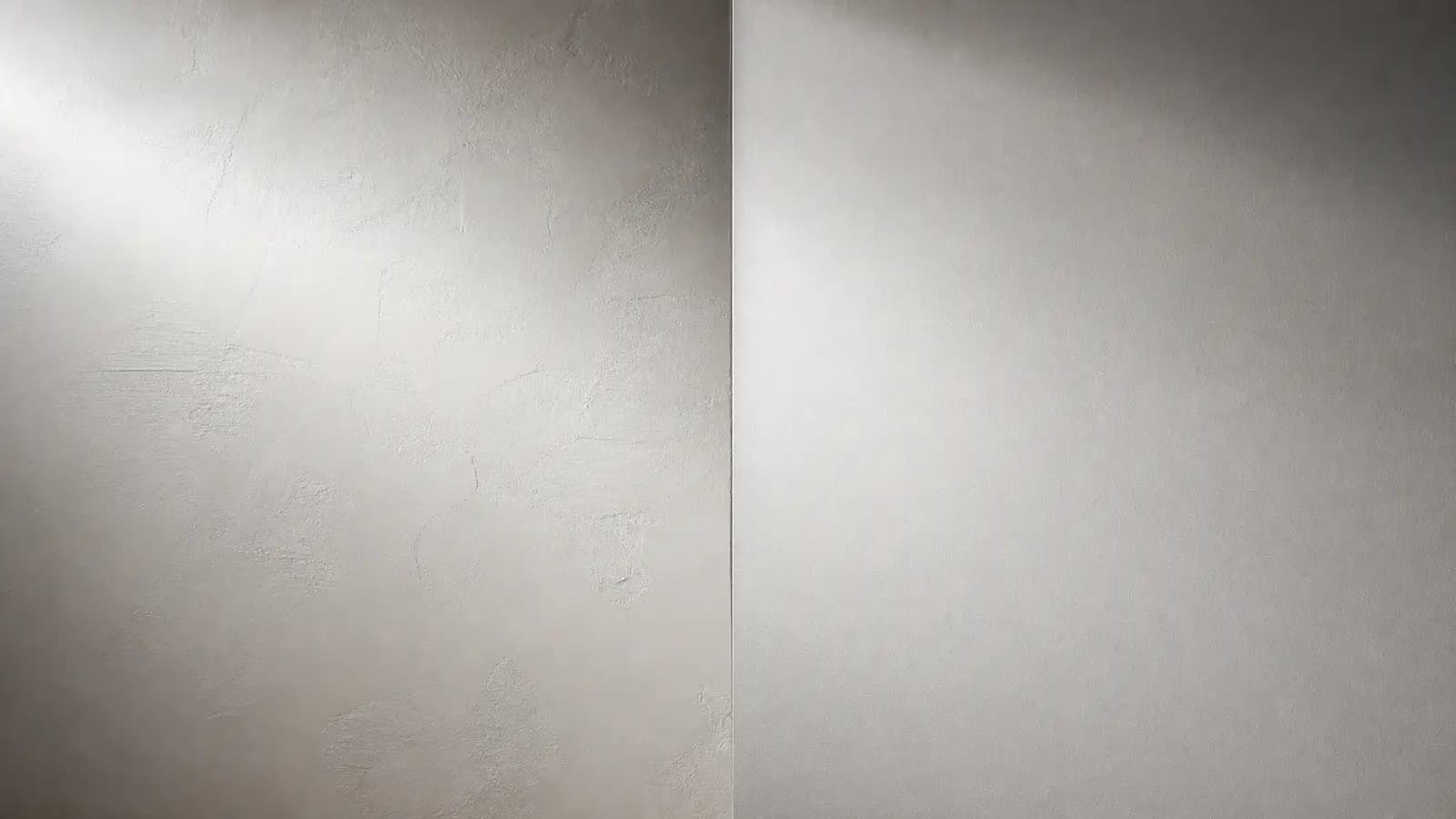
According to Gypsum Association standard GA-214-2022, Level 4 drywall finishing coats only the taped joints and fastener heads (leaving bare face paper across ~80% of the wall), whereas a true GA-214 Level 5 finish applies a continuous, 100% full-surface skim coat across the entire gypsum board. In Western Washington homes with open-concept floorplans, two-story great rooms, and floor-to-ceiling south-facing windows, Level 5 is mechanically required to eliminate joint photographing (sheen flashing) and microscopic seam shadows under low-angle raking sunlight and high-sheen architectural paints.
Why do smooth drywall walls look lumpy under afternoon sunlight?
Every homeowner who has built a custom home or completed a major remodel in the South Sound has experienced the 2:00 PM surprise.
In the morning under ambient indoor lighting, your living room walls look flat, clean, and modern. But as the afternoon sun descends over Puget Sound, low-angle natural light pours through your expansive windows, washing horizontally across your open living areas.
Suddenly, what looked like a flat wall reveals subtle vertical ridges, faint fastener depressions, and dull streaks wherever the seams run.
You aren't imagining things, and your painter didn't necessarily use bad paint. What you are seeing is a fundamental building science phenomenon called joint photographing (or sheen flashing) caused by the physical difference between standard Level 4 drywall taping and architectural Level 5 full-surface finishing.
What is the difference between Level 4 and Level 5 drywall finishes?
| Feature / Metric | Standard Level 4 Finish | Architectural GA-214 Level 5 Finish |
|---|---|---|
| Surface Coverage | Joint compound covers seams and fasteners only (~20% of surface) | Formulated finishing compound covers 100% of entire wall |
| Substrate Texture | 80% bare paper face / 20% sanded joint compound | 100% continuous, ultra-fine mineral compound |
| Porosity Rate | Uneven: Gypsum paper absorbs paint resin faster than mud | Equalized: Entire surface absorbs primer uniformly |
| Visual Under Direct Light | Seams show as subtle dull or shiny bands (flashing) | Optically flat, monolithic surface with zero banding |
| Recommended Paint Sheens | Flat (Matte) only | All Sheens: Matte, Eggshell, Satin, Semi-Gloss, High-Gloss |
| Recommended Lighting | Ambient, diffuse ceiling lights; small windows | Critical Raking Light: Floor-to-ceiling windows, south exposure |
| 2026 South Sound Cost | $2.85 - $5.40 / sq. ft. (total new build install) | $4.30 - $7.50+ / sq. ft. (total new build install) |
What are the official Gypsum Association (GA-214) finish levels?
To understand why walls look different under light, we look to the official authority on interior gypsum construction: Gypsum Association Document GA-214 (Recommended Levels of Finish for Gypsum Panel Products), which is incorporated into ASTM C840 and the International Building Code (IBC).
GA-214 establishes six distinct finish levels (0 through 5), each designed for specific lighting conditions, surface coatings, and room uses:
- Level 0: Gypsum boards attached to framing; no tape, compound, or accessories. Used for temporary construction or uninspected dust separation.
- Level 1: Joint tape embedded in compound; tool marks and ridges permitted. Used for fire-taping in concealed plenum spaces, attic chases, and service corridors.
- Level 2: Tape embedded with one thin wipe of joint compound over seams and fastener heads. Used as substrate for water-resistant tile backer boards and utility storage.
- Level 3: Tape embedded plus one separate fill coat over seams and fasteners; sanded smooth. Used as substrate for heavy hand textures, Spanish knockdown, or heavy commercial wallcoverings.
- Level 4 (Standard Residential Spec): Tape embedded plus two separate fill coats over joints; fasteners covered; sanded clean. Suitable for flat (matte) paints, light textures, or medium wallcoverings.
- Level 5 (Architectural Luxury Spec): Level 4 base plus a continuous, full-surface skim coat over 100% of the board; polished flat. Non-negotiable for critical raking light, dark pigments, and satin/gloss paint.
Why does Level 4 drywall fail under low-angle window light?
Standard residential construction in Thurston and Pierce counties is almost universally bid and executed to Level 4. On standard bedrooms with small windows, 8-foot ceilings, and flat latex paint, Level 4 performs adequately.
However, contemporary Pacific Northwest architecture features open-concept layouts, vaulted two-story ceilings, south-facing sliding glass walls, and minimalist, trim-free aesthetics. When low-angle sunlight strikes a Level 4 wall at a shallow angle (grazing or raking light), two unavoidable problems emerge:
1. Physical Shadow Banding (The Microscopic Crown)
Even when tapered by an experienced taper, joint compound has physical mass. Seams are feathered 10 to 14 inches outward, creating a microscopic elevation over the tape (typically 1/32" to 1/16" higher than the center of the gypsum board). Under direct frontal light, this curve is invisible. But under raking light from a side window, that tiny elevation casts a long, visible shadow down the entire seam.
2. Substrate Porosity Differential (Joint Photographing)
Gypsum wallboard consists of a dense paper face over a crystallized gypsum core. Joint compound is a mixture of calcium carbonate, water, and binding polymers.
These two materials have radically different porosity rates:
- Drywall Face Paper: Highly absorbent, porous fibrous material.
- Taped Joint Compound: Densely packed, low-porosity mineral filler.
When primer and paint are applied over a Level 4 wall, the face paper absorbs the paint vehicle quickly, creating a flatter texture, while the compound absorbs less, allowing the paint resin to cure into a tighter, shinier film. Under natural light, this creates sheen banding—where you can distinctly trace every taped joint through two coats of paint.
How is a true Level 5 full-surface skim coat applied?
A true Level 5 finish is not simply "sanding a Level 4 wall extra smooth." It is a complete physical transformation of the wall assembly into a monolithic, stone-like plane:
- Structural Level 4 Foundation: Taping, bedding, and applying two distinct fill coats over all drywall joints, inside corners, and fastener heads. Fastener heads are inspected and countersunk flush.
- Monolithic Full-Surface Skim: Formulated finishing compound is mixed to a smooth, creamy consistency and applied across 100% of the wall surface using 14-to-16-inch flexible stainless-steel skimming blades. We trowel tight to fill every microscopic paper pore and eliminate lap lines.
- Directional 500W Grazing Lamp Polish: We inspect every square foot under 500-watt halogen grazing lamps held at a 15-degree angle to the wall. Any 1/64" imperfection is identified and hand-polished with 220-grit micro-abrasives using commercial HEPA-filtered dust extraction systems.
- High-Build Primer-Surfacer Application: We apply commercial high-build drywall primer-surfacer via airless sprayer to achieve a uniform 4-to-6 mil wet film thickness that permanently locks the surface.
How much does a Level 5 drywall finish cost in Western Washington?
Homeowners frequently ask why Level 5 finishing carries a higher price tag than standard drywall taping. In Western Washington's high-wage construction market, Level 5 requires double the skilled labor hours, specialty wide skimming blades, and multi-pass drying cycles.
Based on Washington State ESD Occupational Wage Data (SOC 47-2081) and current South Sound contractor benchmarks, here is how current 2026 project pricing breaks down:
| Scope Stage | Standard Level 4 Finish | Architectural GA-214 Level 5 Finish |
|---|---|---|
| Material Applied | Joint compound on seams/fasteners only (~20% of surface) | Full-coverage formulated finishing compound over 100% of surface |
| Labor Passes | 3 passes (tape, bed, skim joints) | 5 passes (tape, bed, skim joints, full-wall skim, micro-polish) |
| Dust Control | Standard pole sanding | Multi-stage commercial HEPA vacuum extraction |
| Inspection Rig | Ambient room light | 500W directional grazing lamps |
| New Construction (Total Installed) | $2.85 - $5.40 per sq. ft. | $4.30 - $7.50+ per sq. ft. (+$1.45-$3.00/sq. ft. skim upcharge) |
| Retrofit / Texture Conversion | N/A | $3.80 - $6.50+ per sq. ft. (scraping, multi-pass skim & primer) |
| Ceiling Surcharge | +20% to +35% overhead factor | +25% to +40% (gravity & neck-strain labor) |
When is a Level 5 drywall finish actually necessary?
| Room Feature / Project Goal | Standard Level 4 is Sufficient | True GA-214 Level 5 is Required |
|---|---|---|
| Paint Sheen | Flat (Matte) paint only | Eggshell, Satin, Semi-Gloss, or High-Gloss |
| Natural Lighting | Standard windows, diffuse ambient light | Floor-to-ceiling windows, south-facing raking light |
| Ceiling Architecture | Standard 8-foot or 9-foot flat ceilings | Two-story vaulted great rooms, open skylights |
| Wall Pigment | Light off-white, beige, pastel colors | Dark dramatic tones (charcoal, navy, emerald) |
| Wallcovering | Medium textured wallpaper or fabric panels | Unbacked thin wallpapers or smooth gloss paint |
Frequently Asked Questions (FAQ)
Can Solis Interiors convert existing orange peel or knockdown walls to Level 5?
Yes. Converting existing textured walls is one of our most common services across Olympia, Lacey, and Tacoma. We scrape down heavy stipple ridges, apply a high-adhesion bonding primer, and apply two to three successive tight skim coats across the full surface. We sand between each coat with dustless HEPA extractors until the texture is completely buried and the plane is glass-smooth.
Why do painters charge extra if the drywall is only finished to Level 4?
Professional painting contractors following Painting Contractors Association (PCA) Standard P4 inspect substrates before painting. If a homeowner specifies a satin, semi-gloss, or dark sheen over a Level 4 drywall surface with critical lighting, the painter knows the seams will flash. Painters either require the homeowner to sign a lighting defect waiver or sub-contract a finisher to bring the wall to Level 5 first.
What kind of primer is required over a Level 5 skim coat?
According to GA-214 Section 4, a Level 5 finish must be sealed with a high-build drywall primer-surfacer applied via airless sprayer. This creates a uniform 4-to-6 mil wet film thickness that permanently locks the compound and equalizes paint absorption.
Authoritative Standards & References
- Gypsum Association (GA): GA-214: Recommended Levels of Finish for Gypsum Panel Products
- American Society for Testing and Materials (ASTM): ASTM C840: Standard Specification for Finishing Gypsum Board
- Painting Contractors Association (PCA): PCA Standard P4: Inspection and Acceptance of Surfaces Prior to Painting
- Northwest Wall and Ceiling Bureau (NWCB): Northwest Wall and Ceiling Bureau (NWCB)
Schedule a Walkthrough with Solis Interiors
Contact master finisher Jesus Solis for an on-site evaluation, expert substrate consulting, and itemized proposal across the South Sound.
- Direct Phone: (360) 350-8616
- Online Quote Request: Request Level 5 Drywall Estimate
- Service Areas: Lacey, Olympia, Tumwater, Tacoma, Lakewood, DuPont, Gig Harbor, Yelm, Centralia.