

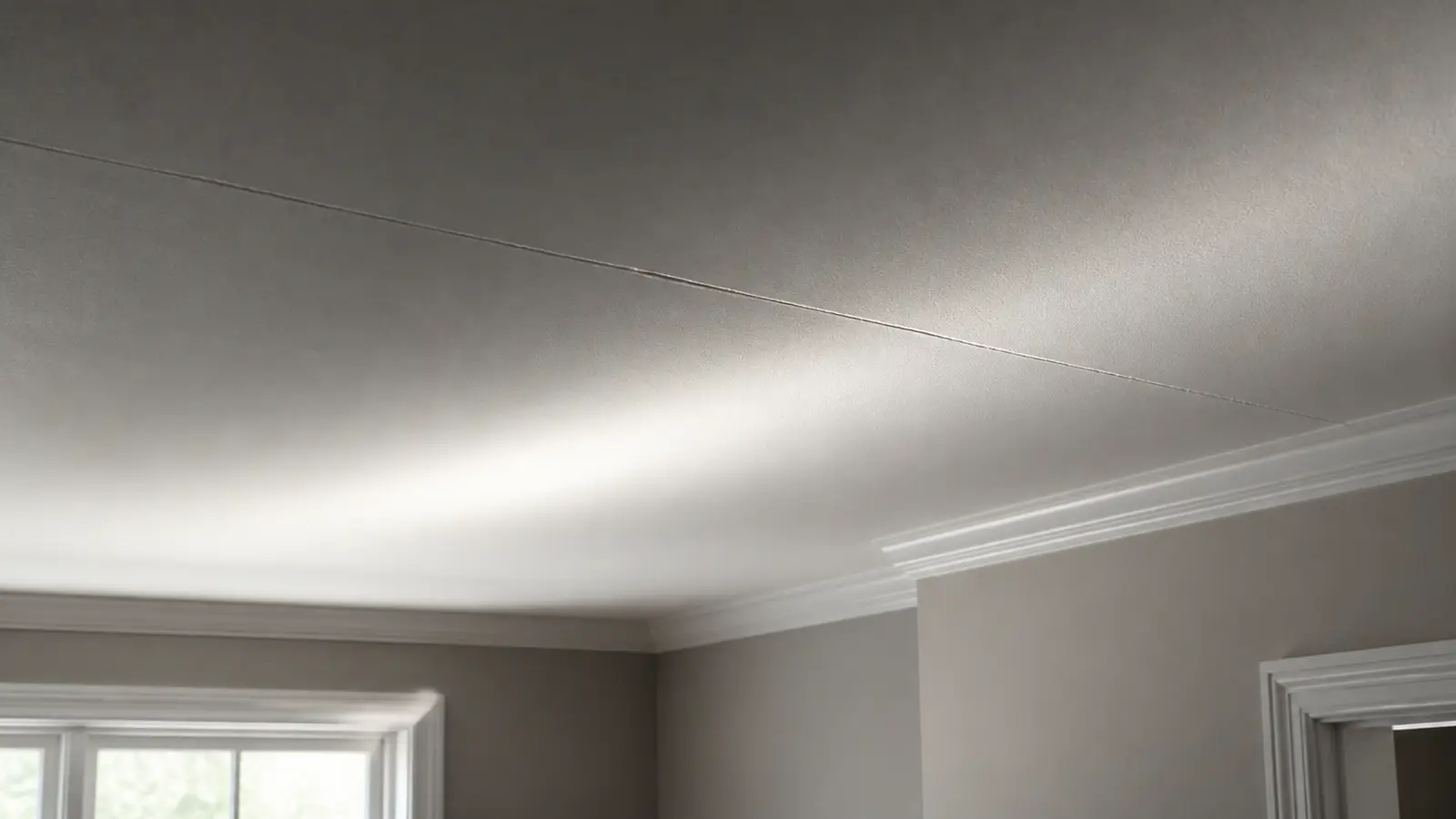
Recurring ceiling cracks along interior wall-to-ceiling corners in Western Washington are almost always caused by roof truss uplift, not foundation settling. During Pacific Northwest winters, high attic humidity and cold ambient air cause the top chords of wood roof trusses to absorb moisture and expand, while the bottom chords remain dry and warm above heated living spaces. This temperature and moisture differential forces the bottom chord to arch upward 1/4" to 3/4", tearing standard rigid drywall tape. A permanent fix requires floating the interior drywall corners using specialized deflection clips or structural composite corner beads rather than rigidly fastening sheetrock to top wall plates. Professional repairs in the South Sound cost $450 to $950 per room.
The Winter Mystery: "I Fixed This Ceiling Crack in August, Why Is It Back in January?"
Homeowners across Lacey, Olympia, and Tacoma are intimately familiar with this frustrating cycle:
During a summer renovation, you patch a long, horizontal crack running along the seam where your living room wall meets the ceiling. You tape it, apply three coats of mud, sand it flat, and paint it. By September, it looks perfect.
Then, around late November or December as temperatures drop and rain sets in across Puget Sound, the crack mysteriously reappears. In some homes, the gap opens up to 1/2-inch wide.
Frustrated homeowners assume their foundation is sinking. But in 90% of South Sound homes built since 1980, foundation settling is not the culprit. The true cause is roof truss uplift—a natural, seasonal physical phenomenon driven by Pacific Northwest weather and wood physics.
The Physics of Roof Truss Uplift in the Pacific Northwest
Modern homes in Western Washington are constructed using engineered wood roof trusses rather than traditional hand-framed rafters. Trusses are exceptionally strong, spanning large open rooms without load-bearing interior partition walls.
However, roof trusses are subject to extreme temperature and moisture differentials between summer and winter:
| Seasonal Factor | Top Chord (Inside Cold Attic) | Bottom Chord (Above Heated Ceiling) | Mechanical Result |
|---|---|---|---|
| Pacific Northwest Winter | Exposed to 35°F-45°F air and 80%-95% outdoor relative humidity. Absorbs moisture and elongates. | Buried in attic insulation; stays warm (70°F) and dry (30%-40% RH). Shrinks or stays stable. | The unequal expansion forces the center of the bottom chord to bow upward (1/4" to 3/4"), lifting off interior partition walls. |
| Pacific Northwest Summer | Attic heats up to 100°F+; top chord dries out and shrinks back to normal length. | Remains at stable indoor conditioned temperatures. | The bottom chord flattens back down onto partition walls, closing the crack until next winter. |
The Mechanical Forces in Action
| Assembly Component | Winter Behavior | Why Rigid Fasteners Fail |
|---|---|---|
| Roof Truss Bottom Chord | Arches upward 1/4" to 3/4" toward the roof peak. | Generates thousands of pounds of upward mechanical lifting force. |
| Interior Partition Wall | Fastened to the floor foundation; remains completely stationary. | Cannot move upward with the ceiling trusses. |
| Rigid Drywall Corner Joint | Screwed tightly into both the wall top-plate and ceiling joists. | Tension Failure: Drywall screws pull through gypsum core or paper tape snaps. |
When original drywall installers rigidly screw ceiling sheetrock directly into interior wall top-plates, that upward arching force tears the paper tape and rips drywall screws straight through the gypsum core.
Why Standard Spackle and Caulking Always Fail
When a homeowner or unqualified handyman sees a ceiling corner crack, their instinctive reaction is to pump elastomeric caulking or spackle into the crack and paint over it.
This fails every single time:
- Caulking Has Elastic Limits: No paintable caulk can withstand 1/2-inch of cyclical seasonal shear movement year after year. The caulk stretches, pulls away from the paint, and leaves an unsightly, rubbery bead hanging from your ceiling.
- Rigid Paper Tape Shears: If you tape over the crack with standard paper drywall tape and all-purpose mud, the upward force of the roof truss acts like a crowbar, snapping the brittle mud bond the moment winter temperatures drop below 40°F.
The Permanent Solution: The Floating Interior Corner System
Under Gypsum Association Document GA-214 and standard drywall engineering practices, preventing truss uplift damage requires disconnecting the ceiling drywall from the interior wall partition:
- Fastener Extraction & Inspection: We remove all drywall screws from the ceiling drywall within 12 inches of the interior partition wall, and all screws from the wall drywall within 8 inches of the top plate. This allows the ceiling drywall to flex smoothly across a 12-inch span rather than snapping along a hard corner.
- Structural Truss Clip Installation: We secure the ceiling drywall edge using specialized slotted drywall clips or metal backer angles attached to the top of the wall studs. The clips hold the drywall firmly in plane while allowing the wood truss to slide up and down freely inside the attic without moving the ceiling board.
- Flexible Structural Composite Corner Beads: We replace torn paper tape with high-tensile structural composite deflection corner beads. These advanced polymer beads feature built-in expansion gaskets that absorb seasonal truss movement without cracking the finished paint surface.
- High-Build Finishing & Texture Blending: We bed the composite bead in low-shrinkage chemical hot mud, feather the joint 12 to 16 inches outward, and match the surrounding ceiling texture for an invisible repair.
2026 Ceiling Crack Repair Pricing in Thurston & Pierce County
Repairing recurring ceiling cracks requires skilled diagnostic inspection, fastener extraction, structural corner backing, and custom texture matching.
Based on 2026 Western Washington trade labor rates, here is what South Sound homeowners can expect:
| Project Scope | 2026 South Sound Cost Range | What is Included in the Scope |
|---|---|---|
| Single Room Floating Corner Repair (Up to 20 lin. ft.) | $450 - $750 | Screw removal, deflection clip installation, structural composite bead, hot mud, texture match |
| Large Great Room / Vaulted Ceiling Repair (25-50 lin. ft.) | $750 - $1,250 | High-reach scaffolding, multi-point deflection joints, wide feathering, pneumatic spray texture |
| Whole-Home Truss Uplift Remediation (3-5 Bedrooms) | $1,800 - $3,600 | Complete home mitigation package, floating all interior partition seams, corner-to-corner primer |
| Turnkey Painting Add-On (Ceiling / Wall Color-Match) | +$1.20 - $2.50 / sq. ft. | Professional corner-to-corner primer and 2 coats premium ceiling/wall paint |
Frequently Asked Questions (FAQ)
How do I know if a ceiling crack is truss uplift or foundation settling?
- Truss Uplift: Cracks run horizontally along the junction between the ceiling and interior non-load-bearing partition walls (hallways, bedroom dividers). The crack opens in winter and closes in summer.
- Foundation Settling: Cracks typically run diagonally from door or window corners down toward the floor, doors stick in their frames year-round, and gaps do not close in warm weather.
Will truss uplift damage the structural integrity of my roof?
No. Truss uplift is a cosmetic nuisance that affects interior drywall finishes, not the structural capacity of your roof trusses. Your roof remains fully safe and load-bearing; the issue is solely the mechanical connection between the wood trusses and the interior drywall.
Can crown molding hide truss uplift cracks?
Yes, but only if installed correctly. If crown molding is nailed to both the wall and the ceiling, truss uplift will tear the molding off the wall. To work properly, crown molding must be nailed only to the ceiling, allowing the bottom of the molding to slide up and down over the painted wall surface invisibly.
Authoritative Building Standards & References
- Gypsum Association (GA): GA-214: Recommended Levels of Finish for Gypsum Panel Products
- Building Science Corporation: BSI-088: Roof Truss Uplift and Interior Partition Deflection
- International Residential Code (IRC): IRC Section R802: Wood Roof Framing & Partition Connections
Schedule a Walkthrough with Solis Interiors
Contact master finisher Jesus Solis for an on-site evaluation, expert substrate consulting, and itemized proposal across the South Sound.
- Direct Phone: (360) 350-8616
- Online Quote Request: Request Ceiling Repair Estimate
- Service Areas: Lacey, Olympia, Tumwater, Tacoma, Lakewood, DuPont, Gig Harbor, Yelm, Centralia.