

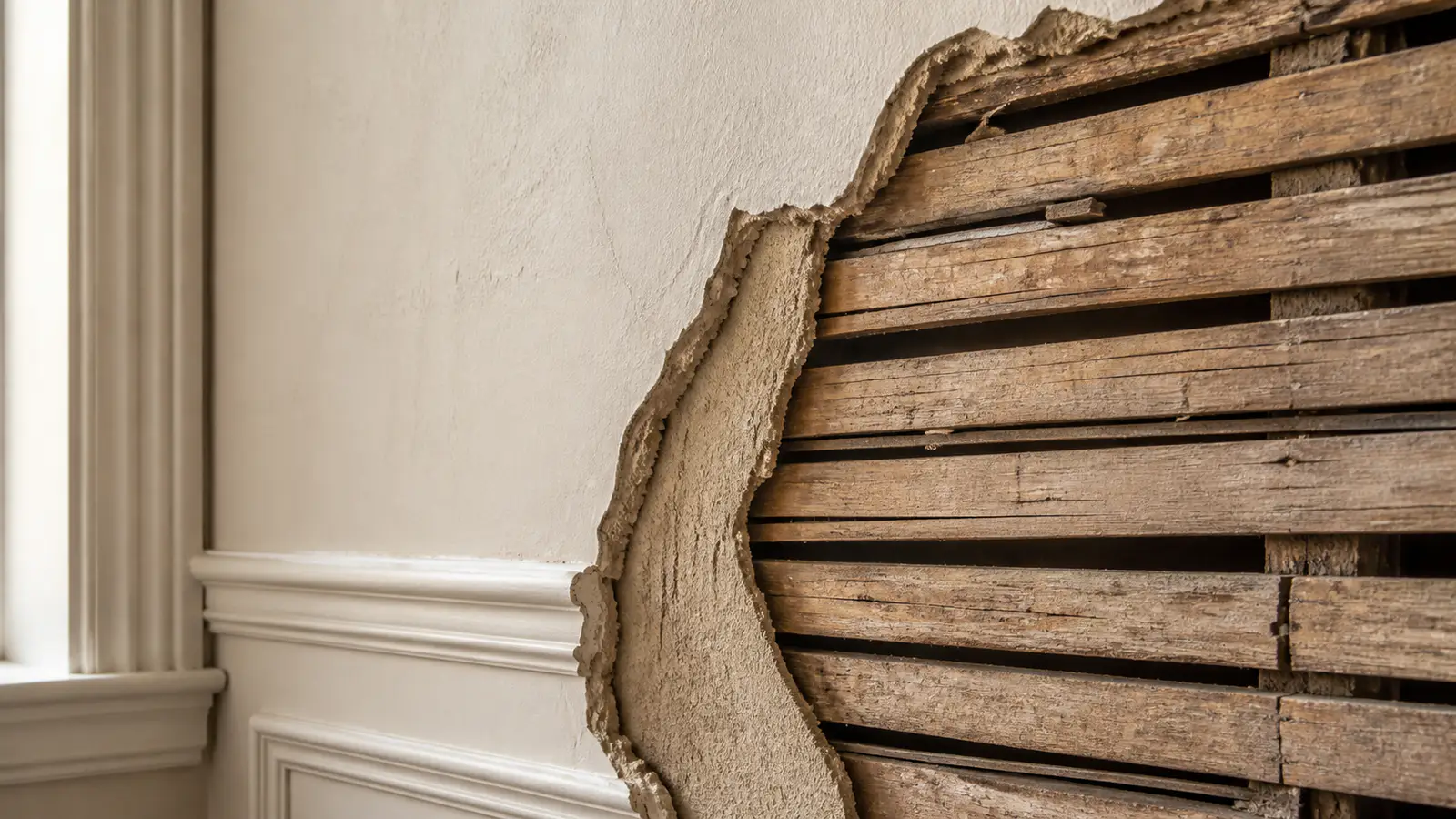
In historic Craftsman, Victorian, and Tudor homes across Tacoma's North End, Stadium District, and Proctor neighborhood, interior walls are constructed of three-coat lime and gypsum plaster over horizontal wood lath. Plaster cracks and bulging "spongy" walls occur when the mechanical plaster "keys" behind the wood lath snap due to historic foundation settling and seasonal humidity expansion. Rather than destructively gutting original walls down to studs—which destroys historical architectural character and natural sound dampening (STC 48+)—Solis Interiors re-anchors loose plaster keys using injected acrylic conditioning adhesives and perforated plaster washers, followed by a full-surface Level 5 skim coat. In 2026, historic plaster stabilization in Tacoma ranges from $650 to $1,850+ per room.
The Heritage Home Dilemma: "Can My Old Plaster Walls Be Saved?"
Tacoma is home to some of the finest historic residential architecture in the Pacific Northwest. From the 1890s Victorians of the Stadium District to the 1920s Craftsman bungalows of the North End and Proctor, these homes feature handcrafted character that modern drywall rarely matches.
However, after 90 to 130 years of Pacific Northwest damp winters, traffic vibration, and natural timber settling, plaster walls begin to show their age:
- Hairline spiderweb cracks spread across living room ceilings.
- Walls develop soft, bulging sections that feel "spongy" or loose when pressed.
- Entire chunks of plaster break away around window casings and door frames.
When homeowners consult general contractors, the standard advice is often destructive: "Gut the whole house down to studs and hang 1/2-inch sheetrock."
Tearing out original plaster is messy, expensive, and destroys irreplaceable historic value. In over 85% of cases, historic plaster walls can be structurally stabilized, re-anchored, and skimmed smooth at a fraction of the cost of a full demolition.
The Anatomy of Historic Plaster & Why "Keys" Break
To understand how plaster is saved, you have to understand how it was constructed before the invention of modern sheetrock:
| Assembly Layer | Historical Material Spec | Structural Purpose in Heritage Homes |
|---|---|---|
| Layer 1: Structural Studs | Old-growth rough-sawn 2x4 fir framing | Foundation backing for horizontal lath strips |
| Layer 2: Wood Lath Strips | 1-1/2" horizontal cedar/fir lath with 3/8" spacing | Flexible substrate providing mechanical gaps |
| Layer 3: Scratch Base Coat | Heavy lime and sand plaster forced between lath gaps | Extrudes between wood strips to form mechanical anchoring keys |
| Layer 4: Brown Leveling Coat | Thick gypsum and sand mortar coat | Levels structural plane across framing deviations |
| Layer 5: Lime Finish Coat | 1/8" ultra-hard lime putty finish | Monolithic glass-smooth final painted surface |
| Plaster Layer / Component | Physical Function | Failure Mode |
|---|---|---|
| Wood Lath Strips | Narrow horizontal wood strips nailed across wall studs with 3/8" spacing. | Expands and contracts with South Sound winter humidity; nails loosen over time. |
| Plaster "Keys" | When the base coat was troweled, wet plaster squeezed between lath gaps, slumping over the back to form hook-like "keys." | Mechanical Key Failure: Foundation vibration and wood expansion snap the brittle plaster hooks. Plaster pulls away from lath, creating a loose, bulging wall. |
| Lime Finish Coat | Hard, dense top layer providing a glass-smooth surface. | Brittle surface cracks along stress lines when underlying keys fail. |
Plaster Stabilization vs. Total Demolition: Cost & Quality Comparison
| Project Metric | Preserving & Re-Anchoring Plaster | Gutting to Studs & Hanging Sheetrock |
|---|---|---|
| Acoustic Soundproofing | Maintained (STC 48-52): Dense 3/4" mass blocks room-to-room sound. | Degraded (STC 33-35): Thin 1/2" sheetrock requires costly sound channel upgrades. |
| Historic Molding & Trim | 100% Preserved: Baseboards, picture rails, and window casings stay intact. | High Damage Risk: Removing trim often splinters antique old-growth fir moldings. |
| Demolition Dust & Waste | Minimal; localized containment with zero heavy debris. | Massive heavy debris (several tons of masonry rubble); extreme dust hazard. |
| Lead Paint & Asbestos Risk | Sealed in place under skim coat (safe encapsulation). | Triggers hazardous material testing, containment, and abatement permits. |
| 2026 Tacoma Restoration Cost | $650 - $1,850 per room (complete stabilization & Level 5 skim) | $3,800 - $7,500 per room (demo, disposal, new framing prep, hanging, taping) |
The Solis 5-Stage Plaster Restoration Workflow
At Solis Interiors, our master craftsmen utilize specialized preservation techniques developed for historic structures:
- Acoustic Tap Inspection & Mapping: We tap the entire wall surface with wooden mallets. A crisp, sharp tone indicates solid keys; a hollow, dull thud identifies detached, spongy plaster zones.
- Precision Injection Re-Anchoring: In loose areas, we drill 3/16-inch pilot holes through the plaster into the lath cavity. We inject a specialized commercial acrylic conditioning adhesive that flows behind the wood lath, bonding the plaster permanently back to the wood framing.
- Plaster Washer Mechanical Clamping: While the adhesive cures (24 hours), we install countersunk perforated plaster washers secured with stainless-steel screws, pulling the sagging plaster firmly flush against the wood lath.
- High-Tensile Fiberglass Mesh Bridging: We bridge structural stress cracks using continuous rolls of high-tensile fiberglass mesh bedded in low-shrinkage chemical-setting compound to prevent future settling movement.
- Monolithic Level 5 Full-Surface Skim: We apply two successive tight skim coats of formulated finishing compound across 100% of the wall surface. Once cured, the wall is hand-polished under 500W grazing lamps using commercial HEPA dust extractors, restoring an authentic, monolithic, glass-smooth surface.
2026 Historic Plaster Repair Pricing in Tacoma & Pierce County
Historic plaster preservation is artisan craft work requiring specialized structural adhesives and wide hand troweling:
| Project Scope | 2026 South Sound Cost Range | What is Included in the Scope |
|---|---|---|
| Hairline Spiderweb Crack Repair (Single Room) | $450 - $750 | V-groove scraping, fiberglass mesh bedding, 3-pass feathering, PVA sealer |
| Loose Plaster Re-Anchoring & Key Stabilization (1 Room) | $850 - $1,650 | Adhesive injection, plaster washer clamping, mesh reinforcement, skim coat |
| Full Room Plaster Restoration & Level 5 Skim Package | $1,450 - $2,800 | Full-room key re-anchoring, 100% full-surface skim coat, dustless HEPA sand, prime & paint |
| Ceiling Plaster Sag Remediation (Up to 150 sq. ft.) | $1,100 - $2,200 | Overhead washer clamping, adhesive injection, wide floating, dead-flat ceiling paint |
Frequently Asked Questions (FAQ)
Can you match the slight hand-undulation of historic plaster?
Yes. While modern homes favor optically flat Level 5 surfaces, historic Tacoma homes often feature subtle, organic hand troweling. Solis Interiors can tailor the final skim coat to be either perfectly modern and flat or softly textured to match the period-correct character of your 1910 Craftsman or Victorian home.
How messy is historic plaster repair?
Because we stabilize and re-anchor plaster rather than demolishing it, our process creates 90% less dust and zero heavy masonry waste. All sanding is performed with commercial HEPA-filtered vacuum extractors, and all doorways are isolated with floor-to-ceiling plastic containment walls.
Will re-anchored plaster crack again?
When combined with structural acrylic adhesive injection and high-tensile fiberglass mesh bridging, our stabilized plaster repairs are stronger and more flexible than original 100-year-old plaster. Solis Interiors provides a 1-year craftsmanship warranty on all historic restorations.
Authoritative Historic Preservation Standards
- National Park Service (NPS) Heritage Preservation Services: Preservation Brief 21: Repairing Historic Flat Plaster - Walls and Ceilings
- Association for Preservation Technology International (APT): Plaster Consolidation and Structural Adhesives
- Gypsum Association (GA): GA-214 Recommended Levels of Gypsum Finish
Schedule a Historic Plaster Walkthrough in Tacoma
Don't let a contractor destroy the historic character and acoustic mass of your heritage home. Contact master finisher Jesus Solis for an expert on-site plaster evaluation and restoration estimate.
- Direct Phone: (360) 350-8616
- Online Quote Request: Request Historic Plaster Restoration
- Service Areas: Tacoma (North End, Stadium, Proctor, Lincoln), Lakewood, Steilacoom, Olympia, Puyallup.